Everything here started as training for paramedic interns. The Master Class Field Guide, the G.O.L.D. Standard, and The Platinum Ten are all in print on Amazon and free as PDFs. The field cards and the tests are free to download below. You can also take every test online and get scored on the spot, with the reasoning behind each answer. Answer keys for the printed tests are sent on request.
The protocol wins. These are study and training aids, not treatment protocols. Protocols get revised and these materials get updated, so check dates and always follow your current local protocols and medical direction.
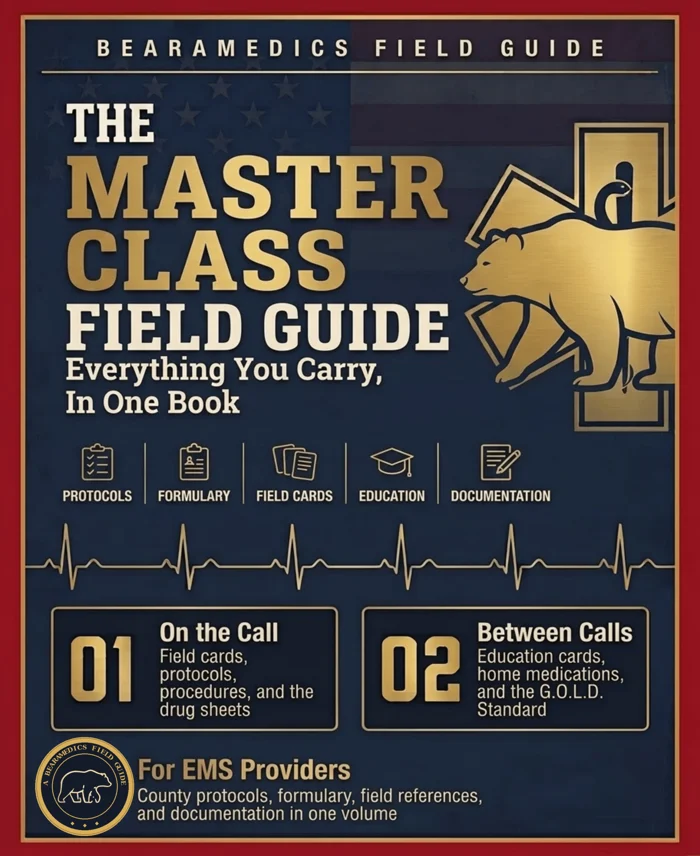
Everything you carry, in one book. County protocols, formulary, field cards, education, and documentation in a single volume for EMS providers.
Paperback and hardcover: pick your format on Amazon. Ask the Field Guide is an AI study aid built on the book (Google NotebookLM). Open it, sign in with Google, and type your question in the box at the bottom. Verify answers against current protocols.
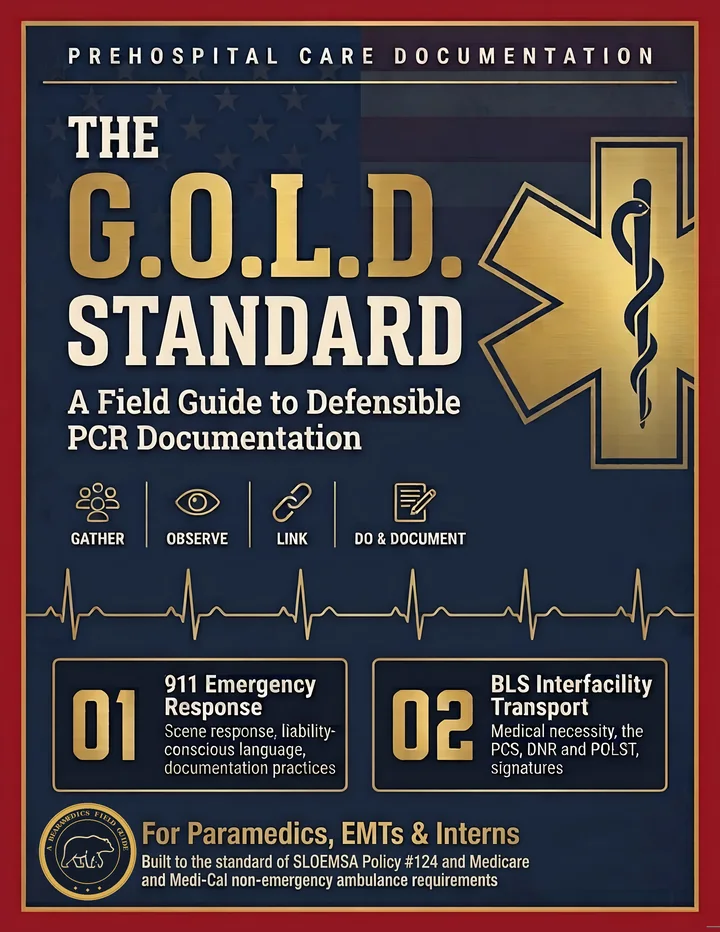
A field guide to defensible PCR documentation. Gather, Observe, Link, Do and Document, built to the standard of SLOEMSA Policy #124 for paramedics, EMTs, and interns.
Paperback.
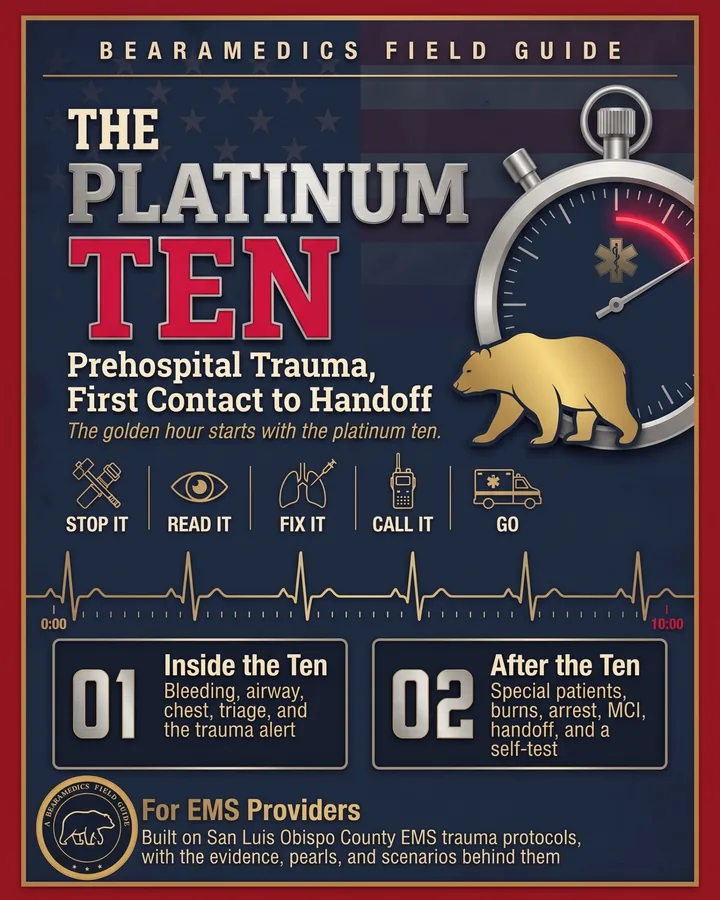
Prehospital trauma, first contact to handoff. Built on the SLO County EMS trauma protocols, with the evidence, pearls, and scenarios behind them. The golden hour starts with the platinum ten.
Paperback and hardcover: pick your format on Amazon.
No ebook to buy. Send any free PDF here to your Kindle and it lands in your library, free.
It stays a PDF, page for page like the print book, so it reads best on a larger Kindle, a tablet, or the Kindle app.
Updated as protocols change. Check the version date on the title page.
Field differentials, crew task flows, and ECG recognition. Ten two-sided cards from chest pain and respiratory distress through the 12-lead speed read and ECG zebras, with the G.O.L.D. Standard quick reference on the back cover.
The why under the wound. Five two-sided cards for the trauma block: bleeding and junctions, pelvis and belly, head, spine and neck, chest and skin, and special bodies with the whole picture. Each card ties the anatomy to a field decision and the SLO County protocol it supports, and each is followed by a two-sided anatomy image sheet. Print double-sided, flip on the long edge, and laminate.
The why behind the field cards, for study between calls. Strokes, capnography, toxidromes, diabetic emergencies, heart failure and CPAP, dialysis and LVADs, burns, pediatrics, heat and cold, and bites and stings.
Airway and Respiratory, Cardiac and Arrest, Medical, Trauma with Environmental and OB/Peds, and Formulary. Built on San Luis Obispo County EMS protocols, weighted toward ALS.
Rhythm identification, strip plus clinical context to treatment, and integrated field scenarios. Answer key available on request.
About 30 drug classes with brand and generic names, plus why each one matters when you find it on a patient's kitchen counter.
Read the ending, know the class, catch the danger. About 35 generic-name endings grouped by body system, with why each one matters on scene, the red flags on a med list, and the suffix traps that fool people.
Trauma on the front, medical on the back, in the order the current NREMT EMT psychomotor sheets grade you on: point values, critical fails, the GCS, and the street-order notes. More on the EMT side.
Med math practice with a clock and a hungry bear. Conversions, weight-based doses, volumes, drip rates, infusions, and oxygen tank times, with made-up orders so the math is the only thing on the test.
Read new material before it is posted and tell me where it is confusing, clunky, or wrong. Open to anyone, in EMS or not.
The Plumbing, The Cell, The Wiring, Reading the Wiring, Rhythms, When It Breaks, and The Drug Box. For any first responder, any license level.